

Sea turtles, the gentle giants of the marine world, have roamed the oceans for millions of years. Among these ancient mariners, the leatherback sea turtle holds the record for size. As the largest of all living turtles, this marine turtle’s size is not just impressive, but also serves a functional purpose, allowing it to navigate across vast oceans and dive to great depths in search of jellyfish, its primary diet.
While all sea turtles play crucial roles in marine ecosystems, leatherbacks are particularly noteworthy for their epic migratory patterns, which often span the entire breadth of oceans. Understanding the scale of their size and the implications it has on their survival and migratory behaviors is integral for conservation efforts. Leatherback turtles are not just remarkable for their size; they are a symbol of the health of our oceans, influencing the cultures, economies, and environments of the coastal communities with which they have coexisted for centuries.
World Record Sea Turtle

This section provides a detailed look into the Dermochelys coriacea, commonly known as the leatherback sea turtle, which is the largest of all living turtles.
Species and Taxonomy
The leatherback sea turtle, Dermochelys coriacea, is a member of the Dermochelyidae family, within the superfamily Chelonioidea. It is the only extant species in its genus. These turtles are classified under the order Testudines, making up one of the oldest reptilian groups in the world, living alongside dinosaurs.
Physical Characteristics
Leatherbacks are distinctly known for their leathery, rather than bony, carapace. This feature sets them apart from other chelonians. Instead of scales, their skin covers a matrix of fused bone known as osteoderms. Adult leatherbacks typically have a carapace length of about 1.5–2 meters (5–6.5 feet) and can weigh up to 700 kg (1500 lbs). The largest leatherback on record was over 3 meters (9.8 feet) from flipper to flipper.
Historical Records and Comparison
The leathery turtle’s size pales in comparison to the extinct Archelon, which was part of the Protostegidae family during the Late Cretaceous period. Specimens like Archelon ischyros, found in South Dakota, indicate that turtles in the past, like dinosaurs, could achieve much larger sizes.
Habitat and Feeding Behavior
Leatherbacks are highly migratory and have been identified in waters as far north as Canada, though they are typically found in the tropics. They are known for feeding on jellyfish, but their diet can also include fish, mollusks, and squid. Due to their pelagic lifestyle, they also frequently encounter marine pollution, which can be mistaken for jellyfish and ingested.
Reproduction and Life Cycle
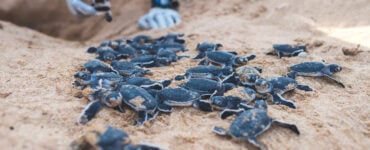
The reproductive cycle of the leatherback sea turtle involves long migrations to tropical and subtropical beaches for egg laying. Females return to the beaches where they were hatched to lay their eggs. The incubation period for these eggs can vary, but upon hatching, the juveniles immediately make their way to the sea.
Threats and Conservation
Leatherbacks are currently listed as vulnerable by the IUCN. They face numerous threats, including marine pollution, like plastic ingestion, predators such as sharks, and human activities such as hunting. Conservation efforts are in place globally, focusing on nesting sites protection, pollution mitigation, and reducing fisheries bycatch to help this ancient species survive.
Significance in the Ecosystem

Sea turtles hold a vital role in marine ecosystems. These ancient navigators contribute significantly to the ecological balance of the ocean’s habitats, and their influence extends across species and borders.
Role in Ocean Ecology
Sea turtles are integral to marine ecology, serving as both predators and prey. Green sea turtles graze on seagrasses and algae, maintaining the health of seagrass beds and coral reefs which are home to numerous marine species. The leatherback sea turtle, the largest of the sea turtles, feeds on jellyfish, helping to control jellyfish populations which might otherwise bloom and disrupt marine ecosystems.
- Predation: Consume vast amounts of jellyfish (leatherbacks), algae, and seagrasses (green sea turtles)
- Habitat maintenance: Help maintain the health of coral reefs and seagrass beds
Interactions with Humans and Impact
The interaction between sea turtles and humans has a profound impact on both. Bycatch — the accidental capture of marine turtles in fishing gear — is a major threat to them. However, sea turtles also contribute to coastal economies through tourism. Marine pollution, including plastic waste, endangers the health of these turtles, affecting their reproduction and survival rates.
- Bycatch: Accidental capture in fishing gear threatens survival
- Tourism: Contributes to local economies
- Marine Pollution: Plastics and other waste pose a critical threat
Cultural and Scientific Importance
The significance of sea turtles extends beyond ecology and into the cultural and scientific realms. Seen as symbols of resilience and longevity, they have cultural importance to coastal communities. From a scientific perspective, the evolutionary history of sea turtles offers insights into taxonomic and evolutionary pathways. Specimens, like those at the National Museum Cardiff, help to enhance our understanding of these creatures.
- Cultural: Symbols in coastal traditions
- Scientific: Provide insights into taxonomy, evolution, and the effects of environmental changes
Future Prospects for Sea Turtles
Conservation efforts are critical for the future of sea turtles, which are listed as endangered or vulnerable by the IUCN. Protecting nesting sites, reducing bycatch, and addressing marine pollution are essential components of sea turtle conservation. Each species, from Kemp’s ridley sea turtle to the flatback sea turtle, faces its own distinct challenges in the battle for survival.
- Conservation Efforts: Protect nesting sites, address marine pollution
- Legislation: Implement laws to reduce bycatch, enhance marine protection


Add comment