

The pursuit of record-breaking bluegill has long fascinated anglers. Bluegill, a member of the sunfish family, is a popular target for freshwater fishermen due to their wide distribution and feisty nature upon being hooked. Anglers appreciate bluegills not only for the sport but also for their culinary value. While the average bluegill caught by recreational fishermen is modest in size, tales of catching unusually large specimens have always intrigued and inspired those seeking a noteworthy catch.
State and national fishing records maintain a catalog of the largest individuals caught for different species. These records are meticulously documented, providing a benchmark for anglers to aspire to. Achieving a place on the record list is a celebrated milestone, and the title of catching the ‘biggest bluegill’ carries significant prestige. While the specific details of the largest bluegill ever caught may vary depending on the source, the enthusiasm for landing a record-breaking fish remains a consistent thrill among fishing enthusiasts.
Historical Records and Notable Catches

Bluegill enthusiasts and anglers alike often seek to understand the benchmarks of size and weight that make for legendary catches. Historical records serve as testament to the upper limits of bluegill sizes and the waters that have produced these notable specimens.
World Record Bluegill
The world record bluegill was caught by T.S. Hudson on April 9, 1950. Weighing in at an impressive 4 pounds 12 ounces, this record-setting fish was pulled from Ketona Lake, Alabama and remains the benchmark for size in the bluegill angling community. The International Game Fish Association (IGFA) stands as the verifying body for this and other world fishing records.
State Records and Trophy Catches
Each state in the United States maintains its own record books for the largest bluegills caught within their waters. Notable state records include:
- Kentucky: Kentucky anglers take pride in their bluegill fishing, with the state record weighing 4 pounds 3 ounces.
- North Carolina: A state known for its diverse fishing habitats has recorded 4-pound bluegills as their top catches.
- Arizona, California, Colorado, Florida, Georgia, Idaho, Illinois, Maryland, Mississippi, Oklahoma: Each of these states boasts bluegill catches exceeding 2 pounds, marking them as premier destinations for trophy bluegills.
Prominent Lakes and Locations
Not just any body of water can claim to have produced record bluegills. Certain lakes and locations across North America are renowned for their capacity to grow bluegills of significant size. Some of these locations include:
- Ketona Lake, Alabama: Aside from producing the world record, Ketona Lake has a reputation for large bluegills.
- Lakes throughout Florida and Georgia: With warm climates conducive to year-round growth, these states’ lakes often yield hefty bluegills.
- Midwestern states such as Illinois and Kentucky: These locations are favored by anglers for their consistency in producing sizable catches.
In pursuit of the largest bluegill ever caught, anglers often venture to these and other North American waters, hoping to land a fish that will etch their name into the record books.
Bluegill Biology
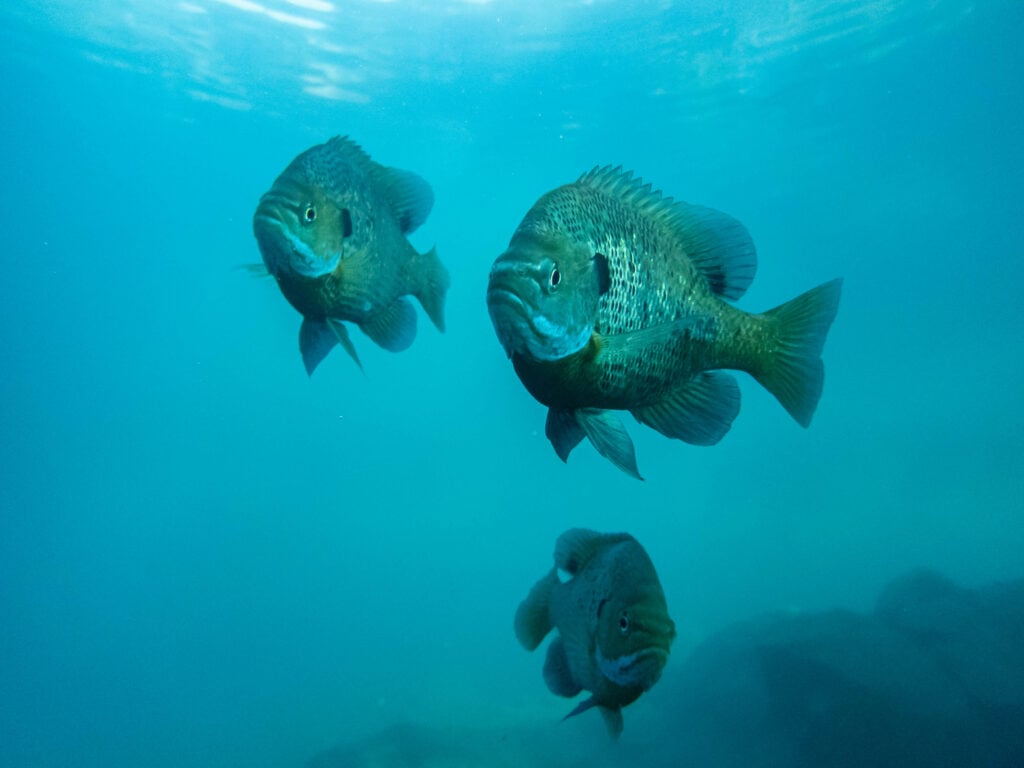
In this section, we delve into the biology of bluegills and how anglers can apply effective methods to catch these popular freshwater fish. We’ll also touch on the importance of conservation and ethical fishing practices to ensure bluegill populations thrive in their native habitats.
Understanding Bluegill Biology
Bluegills, a member of the sunfish family, are a prevalent species in rivers, lakes, ponds, and streams throughout North America. With a distinct girth and a dorsal fin often edged in vibrant hues, bluegills are known for their parental care and nesting colonies during the spawning season. Their growth can be influenced by factors such as fishing pressure and habitat quality.
Key Biological Traits:
- Dorsal Fin: Features a unique ‘ear’ spot, which can be useful for species identification.
- Girth: Fully mature bluegills display a laterally compressed, disk-shaped body.
- Growth: Influenced by environmental factors such as habitat complexity and available forage.
Conservation and Ethical Fishing Practices
Conservation is crucial to maintaining bluegill populations and their ecosystems. The International Game Fish Association promotes responsible fishing guidelines to ensure species like bluegill continue to be a sustainable table fare. Ethical practices include proper handling, catch and release where appropriate, and observing limits to prevent overfishing, especially in spawning seasons or private lakes.
Conservation Tips:
- Catch and Release: Employ when fishing in vulnerable areas or during spawning to reduce impact.
- Size and Bag Limits: Follow local regulations to support bluegill population balance.
- Habitat Preservation: Support initiatives aiming to maintain or restore natural freshwater environments.
Through a deeper understanding of bluegill biology and committing to ethical fishing techniques, anglers can enjoy the pursuit of one of the most enjoyable and widely targeted freshwater fish.

Add comment