

Urban legends, such as the sewer alligators narrative, often reflect societal fears and serve as cautionary tales. They have been debated and analyzed by sociologists and folklorists aiming to understand their origins and impacts on society. In the case of New York, the combination of a dense population, media sensationalism, and a mysterious underground world has proven fertile ground for the story of sewer-dwelling alligators to take root and flourish.
The question of whether alligators roam the sewers of New York City has intrigued residents and visitors alike for decades. This urban legend claims that alligators have been living underneath the bustling streets, having been flushed down toilets as unwanted pets and growing to monstrous sizes in the damp labyrinth below. Despite its persistence in popular culture, thorough investigations and urban research have consistently disproved the existence of sewer alligators. The New York City sewer system, while vast and complex, has not provided any concrete evidence of an alligator population within its confines.
History and Mythology of Sewer Alligators

The narrative of sewer alligators in New York City oscillates between fact and fiction, originating from early 20th-century claims and evolving into a permanent fixture in urban folklore.
Early Reports and Public Reaction
In 1907, The New York Times published the first known rumor mentioning a gator in the sewer, sparking public intrigue. The tale gained traction in 1935 when sightings of alligators in the sewers were reported, leading to mixed responses of skepticism and alarm among New Yorkers.
Thomas Pynchon and ‘The World Beneath the City’
Teddy May, New York City’s sewer commissioner during the 1930s, claimed to have encountered alligators below the city, a story that was later brought into the limelight by Robert Daley in his 1959 book, “The World Beneath the City.” This book, which had assistance from Thomas Pynchon, further entrenched the legend into the city’s history.
Popular Culture Influences
Over time, the legend found its way into pop culture. Stories such as Teenage Mutant Ninja Turtles reinforced the idea of reptilian life in the city’s subterranean tunnels. Moreover, an art installation by Tom Otterness called “Life Underground” depicts small bronze alligators seemingly emerging from a manhole, further igniting public imagination about these creatures.
Modern Perspective on the Legend
Today, while the legend persists, figures like Michael Miscione, a Manhattan borough historian, and journalists like Anna Quindlen of the New York Times urge for a differentiation between folklore and reality. Local tours and informative talks, such as those from Untapped New York Insiders, continue to address the blend of myth and truth in the city’s rich tapestry of urban tales.
Alligators, Ecology, and Urban Environment
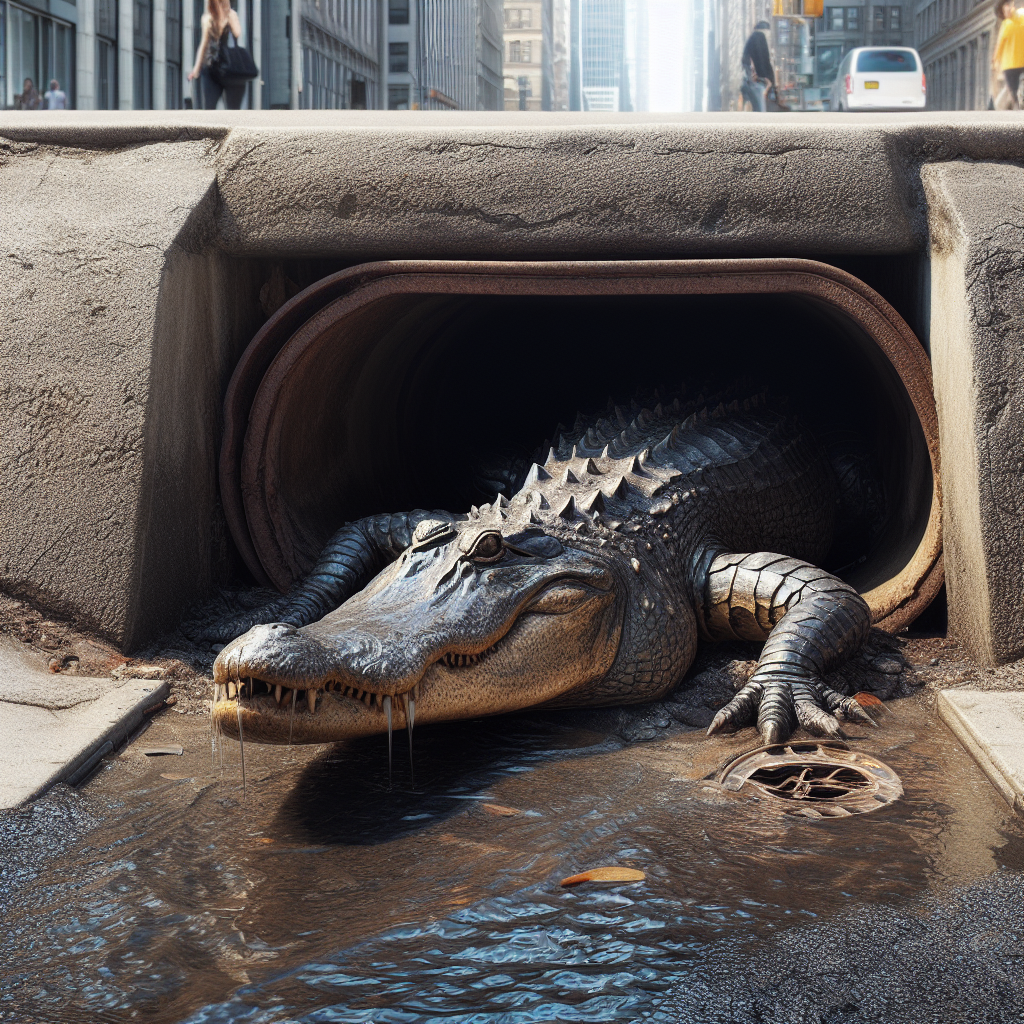
The intersection of wild alligators and the urban ecosystem of New York City has garnered both fascination and skepticism over the years. This section explores the existence of wildlife in the sewers, scrutinizes reported alligator sightings, and considers the environmental and human factors that contribute to this urban legend.
Wildlife in New York Sewers
New York City’s complex sewer system has been rumored to host various animals, from rats to feral cats. The Bureau of Sewers and the Department of Environmental Protection manage this extensive network, which includes the East River and Bronx River waterways. While certain animals can indeed navigate the labyrinth of tunnels, the likelihood of encountering large reptiles such as alligators remains low due to the harsh conditions in the sewers.
The Reality of Alligator Sightings
Historical accounts and urban legends speak of alligator sightings in the city. The Bronx River Parkway Police have occasionally reported such incidents since the 1930s. Most famously, in 1935, a group from East Harlem discovered an alligator emerging from a storm drain. However, verified sightings are rare, and often these tales, such as those involving mutant alligators, are embellished or unsubstantiated.
Environmental and Human Factors
The concept of sewer gators in New York often stems from stories of pets being flushed into the sewer system or released by wealthy families unable to care for them. While the Harlem and Bronx Zoo provide a habitat for alligators in a controlled environment, the conditions in New York’s sewers are inhospitable for such reptiles. Cold temperatures, lack of food, and the city’s sanitation efforts render the sewer a challenging place for an alligator to survive, let alone thrive.




Add comment