
Want to find out more about neon flying squids?

Read on! We’re going to give you the low down on these strange little sea creatures, and answer several of your most frequently asked questions on the subject!
Feel free to scroll ahead to any section that gets your attention.
What is a Neon Flying Squid?
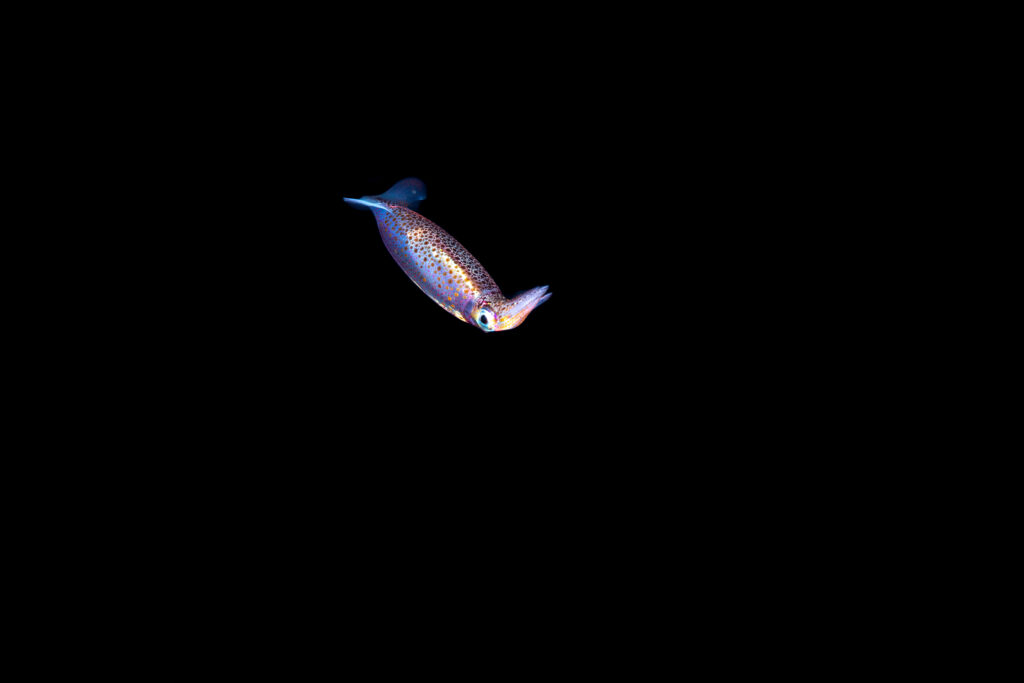
The neon flying squid ( Ommastrephes bartramii ) is also sometimes referred to as a red flying squid, akaika, or simply, red squid.

They can be found in both temperate and subtropical waters in oceans all over the world.
It’s a particularly interesting sea creature for several reasons, one of them being their rather unusual appearance.
They have large eyes, 10 arms and two feeding tentacles. They are mauve in color, but with silver, gold, or bioluminescence on their undersides. A wide variety of luminous organs are present on their mantle, head, arms, viscera and eyes, but this varies with subspecies.
But perhaps even more interesting than their rather striking appearance is their behavior…
During the daytime, neon flying squids spend the majority of their time very deep in the ocean, typically around depths between 300 and 700 meters — although they have been known to descend to depths of almost 1,500 meters on occasion.
Nighttime is a different story however — this is when they wish to feed, and they can be found just beneath the surface at depths between 0 and 70 meters.
Although neon squids are typically known to have a diet consisting of oceanic fishes, they are also known to engage in cannibalistic behavior, and eat their own kind as well.
Neon flying squids have a life cycle of just one year. And during this year they complete a cyclical migration between their spawning and feeding grounds.
Their spawning is continuous rather than seasonal, and during the course of the life of a female neon flying squid they can spawn anywhere between 350,000 to 3.6 million eggs, depending on their size.
These females and the males are both presumed to die shortly after spawning.
Do Neon Flying Squid Jump Out Of Water?
There’s a reason why these squids have “flying squid” in their name. Despite usually remaining deep down in the ocean water during the day, they have often been known to jump aboard the deck of passing ships.

This tends to happen more often when the weather conditions are rough, or when there are predators present in the vicinity.
This is why many people come to the conclusion that this behavior pattern is an instinctive response to a perceived threat.
How High Can A Flying Squid Jump?
Once a flying squid has propelled itself into the air, it contorts itself into a rocket shape, with its fins catching the air as though they are wings, while their tentacles curl up to create another flat surface in the rear.

At this point, the only thing that can limit the flying squid’s movement is the wind.
Occasionally, flying squids have been known to reach distances of a whopping 164 feet at a time into the air.
Do Flying Squid Actually Fly?
Those who study these creatures are still yet to determine the mechanism by which neon flying squids actually become airborne. But many of them agree that the movement that they make has more in common with actual flight, rather than mere gliding.
Moreover, according to Wikipedia, there is at least one piece of photographic evidence indicating that neon flying squids do actually fly, as opposed to merely jumping or gliding.
However, it seems that they only carry out this behavior when it’s dark. And this can explain a few things. It explains why so little is known about how they move when they’re out of the water.
It’s harder for observers to catch them in the act. And, lucky for the squid, this also helps protect them from predators such as birds.
How Much Faster Is A Squid In Air Than In Water?
Did you know that neon flying squid can actually soar in the air faster than world-famous runner Usain Bolt?

They can soar more than 100 feet through the air at a speed of a whopping 11.2 meters per second!
This is significantly faster than Usain Bolt, who can run at a speed of 10.31 meters per second, which he achieved at the London Olympics back in 2012.
As for how fast it moves in different circumstances, this depends on the method they use. They fill up their mantle with water, and then force it out at very high velocities.
When they propel themselves by shooting out a jet of water at high pressure, they move very quickly indeed, and it is only when they then open their fins to glide that they reach the steadier rate of 11.2 meters per second.
This is a great way for these creatures to escape from any prey that may be in the vicinity, and it is thought that they can replicate such movements under the water, too.
However, the ocean water is much denser than the air above, so it stands to reason that they won’t be able to travel quite as fast through the water as they do through the air…
Ron O’Dor, a marine biologist at Dalhousie University in Halifax, Canada, has studied the movement of flying squids and has concluded that their acceleration rate in air is a whopping 5 times faster than any acceleration he’s measured in a squid in water.




Add comment