

The crocodile shark (Pseudocarcharias kamoharai) is a small, deep-water shark found in tropical and subtropical waters around the world. Despite its fearsome name, this shark is not a threat to humans as it rarely comes in contact with them. It is named after its crocodile-like appearance, with its long, pointed snout and sharp teeth.
The crocodile shark is one of the least studied species of pelagic sharks, with limited information available on its biology and behavior. It is currently listed as a species of least concern by the International Union for Conservation of Nature (IUCN), as there is no evidence of significant population declines or threats to its survival. However, given the lack of data on this species, it is important to continue monitoring its populations to ensure its conservation.
Despite its low profile, the crocodile shark has attracted the attention of researchers in recent years, who are working to unravel the mysteries of this elusive species. Studies have focused on its reproductive biology, age and growth, and migratory patterns, shedding light on its role in the marine ecosystem.
Taxonomy and Classification

The Crocodile Shark, also known as Pseudocarcharias kamoharai, is a species of shark that belongs to the family Pseudocarchariidae, order Lamniformes, and genus Pseudocarcharias.
Family Pseudocarchariidae
The Pseudocarchariidae family consists of only one genus, Pseudocarcharias, and one species, the Crocodile Shark. This family is unique among other Lamniformes in that it lacks the typical keels found on the caudal peduncle. Instead, it has a more streamlined body shape, which allows it to move quickly through the water.
Order Lamniformes
The Lamniformes order is a group of sharks that includes some of the most well-known species, such as the Great White Shark and the Hammerhead Shark. These sharks are characterized by their large size, predatory behavior, and distinctive body shape. They are also known for their ability to regulate their body temperature, which allows them to inhabit a wide range of environments.
Genus Pseudocarcharias
The genus Pseudocarcharias contains only one species, the Crocodile Shark. This shark is named for its long, narrow snout and sharp teeth, which give it a crocodile-like appearance. It is a small shark, reaching a maximum length of around 1.1 meters. The Crocodile Shark is found in tropical and subtropical waters around the world, and is known to feed on a variety of small fish and squid.
In summary, the Crocodile Shark belongs to the Pseudocarchariidae family, which is part of the Lamniformes order. It is the only species in the Pseudocarcharias genus, and is known for its unique body shape and predatory behavior.
Physical Characteristics
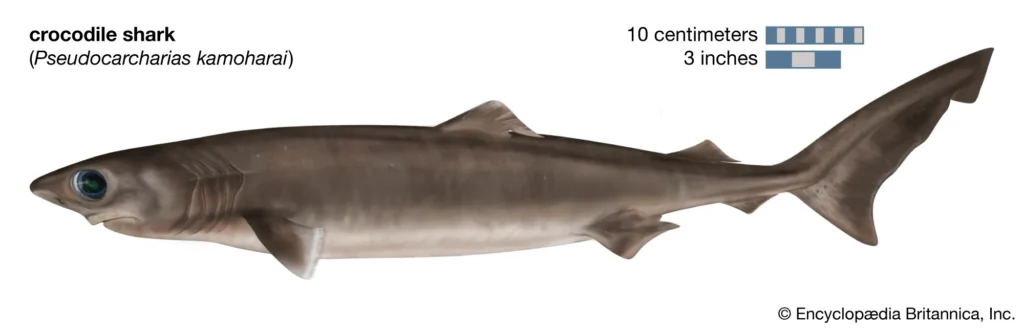
Crocodile sharks are small, slender sharks that are characterized by their distinctive features. They have a spindle-shaped body, long gill slits, and large eyes that are dark brown in color. The shark’s body is covered in small fins that help it to move through the water with ease.
Distinctive Features
One of the most distinctive features of the crocodile shark is its teeth. They have 30 tooth rows in their jaws, which are used to catch and eat their prey. The jaws of the crocodile shark are also quite powerful, allowing them to crush the shells of their prey.
Size and Body Shape
Crocodile sharks are relatively small, growing up to a maximum length of around 1.2 meters. They have a spindle-shaped body that allows them to move through the water quickly and efficiently. Despite their small size, crocodile sharks are powerful swimmers and can cover great distances in search of food.
Teeth and Jaws
As mentioned earlier, the crocodile shark’s teeth are one of its most distinctive features. They have sharp, pointed teeth that are used to catch and eat their prey. The jaws of the crocodile shark are also quite powerful, allowing them to crush the shells of their prey. This makes them well-suited for hunting crustaceans and other hard-shelled prey.
In conclusion, crocodile sharks are small, but powerful sharks that are well-suited for hunting hard-shelled prey. They are characterized by their distinctive features, including their teeth and powerful jaws. Despite their small size, they are powerful swimmers and can cover great distances in search of food.
Habitat and Distribution

The crocodile shark (Pseudocarcharias kamoharai) is a small, elusive species of shark that is found in the tropical waters of the Atlantic, Pacific, and Indian Oceans. They are known to inhabit waters around Japan, Australia, New Zealand, Africa, Korea, Taiwan, and the Bay of Bengal. These sharks prefer to live in deep, open waters, but they have been known to venture closer to shore on occasion.
Geographical Range
Crocodile sharks are found in the Atlantic Ocean, Pacific Ocean, and Indian Ocean. They are known to inhabit tropical waters and are often found in deep waters ranging from 200 to 500 meters. These sharks are commonly found off the coast of Brazil, and have also been observed in waters off the coast of Japan, Australia, and New Zealand. Crocodile sharks have also been caught in the waters off the coast of Ecuador, where they are considered a rare species.
Crocodile sharks are not commonly seen by humans, as they prefer to live in deep waters, and are not typically caught by commercial fishing operations. However, some research suggests that crocodile shark populations may be declining due to an increase in fishing effort within their preferred habitats. Further research is needed to determine the true extent of the crocodile shark’s range and distribution, as well as the factors that may be affecting their population.
Behavior and Ecology
The crocodile shark (Pseudocarcharias kamoharai) is a small, deep-sea shark that inhabits the pelagic zone of tropical and subtropical waters worldwide. This shark is known for its unique physical characteristics, including a long, slender body, narrow head, and large, sharp teeth. In this section, we will discuss the behavior and ecology of the crocodile shark, including its feeding habits, reproductive behavior, and diurnal patterns.
Feeding Habits
Crocodile sharks are opportunistic predators that feed on a variety of prey items, including bony fish, squid, and shrimp. They are known to migrate vertically in the water column, moving from the surface at night to deeper waters during the day in search of prey. According to a study, the crocodile shark feeds on a variety of species, including deep-sea lanternfish, myctophids, and gonostomatids.
Reproductive Behavior
The reproductive behavior of the crocodile shark is not well understood. According to a study, the fecundity of the crocodile shark is four fetuses per litter, with some individuals carrying only one fetus. The gestation period of this shark is unknown, but it is thought to be relatively short, lasting only a few months.
Diurnal Patterns
Crocodile sharks are known to exhibit diurnal patterns in their behavior, migrating vertically in the water column to feed at night and returning to deeper waters during the day. According to a study, crocodile sharks have been observed scavenging on whale carcasses along with apex predators such as sharks and crocodiles during the day. This behavior suggests that crocodile sharks may be active during the day, but further research is needed to confirm this hypothesis.
In conclusion, the crocodile shark is a unique and fascinating deep-sea predator that exhibits a variety of interesting behaviors and ecological adaptations. While much remains to be learned about this species, researchers are making progress in understanding its feeding habits, reproductive behavior, and diurnal patterns.
Conservation and Threats
The crocodile shark (Pseudocarcharias kamoharai) is currently listed as “Data Deficient” by the International Union for Conservation of Nature (IUCN). This indicates that there is not enough information available to determine the species’ conservation status. However, the crocodile shark is considered a vulnerable species due to its low reproductive rate and high susceptibility to bycatch in commercial fisheries.
Human Impact
The crocodile shark faces a number of threats from human activities. One of the biggest threats is bycatch in pelagic longline fisheries, where the sharks are caught unintentionally while fishing for other species. This can have a significant impact on crocodile shark populations, as the species has a low reproductive rate and is slow to mature.
Fishing pressure may lead to crocodile shark population decline. The conservation of the crocodile shark worldwide, as well as the conservation of this shark to decline globally since this main threat is still present. Although sharks represent a very small threat to human life, they are often portrayed negatively in the media, leading to a lack of public support for their conservation.
To mitigate these threats, it is important to improve knowledge of this species and its distribution. This can be achieved through research and monitoring programs, as well as implementing regulations to reduce bycatch in commercial fisheries. Furthermore, public education campaigns can help to raise awareness of the importance of conserving the crocodile shark and other shark species.
Reproduction and Life Cycle
Crocodile sharks are ovoviviparous, meaning the eggs develop inside the female’s body, and the pups hatch inside the uterus. The reproductive biology of crocodile sharks has been studied in various regions of the world, including the tropical Atlantic, Pacific, and eastern Atlantic oceans.
Mating and Gestation
Male crocodile sharks reach sexual maturity at a length of 90-100 cm, while females mature at a length of 100-110 cm. The mating behavior of crocodile sharks is not well understood, but it is believed that they mate during the summer months. After mating, the female crocodile shark undergoes a gestation period of approximately 10-12 months.
Birth and Growth
Crocodile sharks give birth to litters of 4-6 pups every reproductive cycle, and the pups are born at a length of approximately 40-50 cm. The pups are born fully developed and are able to swim and hunt for themselves immediately after birth.
Crocodile sharks have a slow growth rate, and it takes them several years to reach maturity. The life history of crocodile sharks should include the estimation of growth variables, such as age, size, and growth rate, to gain a better understanding of their population dynamics.
In conclusion, crocodile sharks have a unique reproductive biology that is still not well understood. However, studies conducted in different regions of the world have shed some light on their mating behavior, gestation period, and growth rate.
Interaction with Humans
The crocodile shark is occasionally caught by fishing vessels as bycatch. According to a study, the species is often caught by Japanese longliners targeting tuna in the Indian and Atlantic Oceans. The study also suggests that the crocodile shark is one of the least studied of all pelagic sharks, and that more research is needed to understand its population dynamics and interactions with fishing activities.
Scientific Significance
Despite being a relatively unknown species, the crocodile shark has attracted scientific interest due to its unique physical characteristics. The species has been found to have a unique arrangement of teeth, which is different from other sharks. This makes it an interesting subject for further study, particularly in the field of shark evolution.
In addition, the crocodile shark has been found to have a high level of connectivity between the Atlantic and Southwest Indian Oceans, indicating that it plays an important role in the marine ecosystem. This highlights the need for conservation efforts to protect the species from overfishing and other human activities that may impact its population.
Overall, the crocodile shark’s interaction with humans is mainly limited to fishing activities and scientific research. While the species is not known to pose any significant threat to humans, it is important to continue studying and monitoring its population to ensure its conservation and protection.


Add comment