

The phenomenon of fish walking on land may seem like the stuff of science fiction, yet nature’s ingenuity has proven it to be a reality. Certain fish species have developed the astonishing ability to traverse terrestrial environments, a behavior that tantalizes scientists interested in the evolutionary journey from water to land. Observations in regions like South Vietnam have documented four land-dwelling genera of fish that exhibit this ability, advancing our understanding of their capabilities.
The mechanics of how these fish move on land vary, but some employ body oscillations, using stiffened fins to propel themselves forward. Channa, a genus of fish known as snakeheads, represents one of the heaviest fish observed walking out of water today. These examples of terrestrial locomotion in fish offer a glimpse into the evolutionary adaptations that have equipped some aquatic species for short-term forays onto land.
Through the study of these unique behaviors, scientists gain insights into the broader narrative of evolution, exploring hypotheses about the transition of vertebrates from water to land. Research into the locomotor abilities of sarcopterygian fishes—a group that includes lobe-finned fishes and tetrapods—is particularly compelling, suggesting that the precursors to land-dwelling vertebrates might have possessed the capability to lift their bodies using rudimentary limbs. This ability is a significant chapter in the story of life’s persistence and adaptability in the face of ever-changing environments.
Anatomical Adaptations for Terrestrial Locomotion

Certain fish demonstrate remarkable anatomical adaptations that enable them to engage in terrestrial locomotion. These include the modification of fins into limb-like structures and significant changes in their respiratory systems to facilitate air breathing.
Fins to Limbs
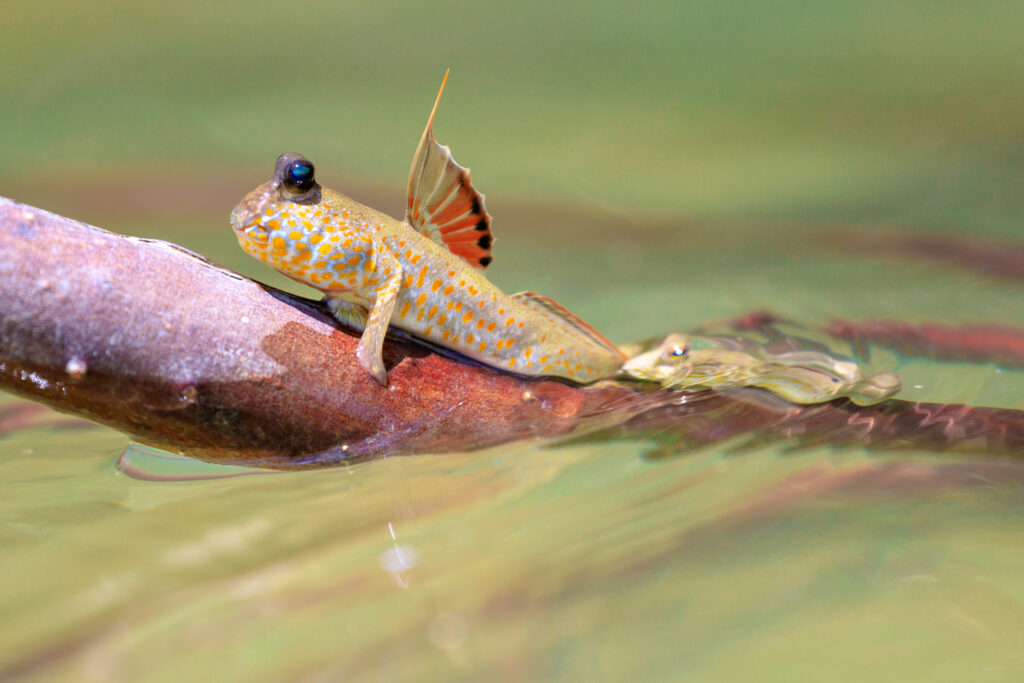
Fish that move on land have evolved fins that are structurally different from those adapted purely for aquatic life. The pectoral and pelvic fins in some vertebrates have transformed to support their body weight on land, presenting an intermediate step between traditional fins and the limbs of land-dwelling animals. For instance, the pectoral fins of the mudskipper are sturdy, allowing them to “walk” across mudflats by supporting their body and performing a series of coordinated movements like those of a crawling tetrapod.
Respiratory System Changes
As fish embark on land, they encounter a new challenge—breathing air. Some species have developed unique adaptations in their respiratory system. Notably, the lungfish and some species of catfish breathe air using lungs, which are either a modification of the swim bladder or an entirely separate organ. These structures enable them to extract oxygen directly from the air, an essential ability for their sojourns on land. Others might use modified gill structures, cutaneous respiration (skin breathing), or even their mouth cavity to exchange gases, all adaptations that showcase the versatility of the respiratory systems in air-breathing fish.
Notable Species Demonstrating Terrestrial Movement

Several fish species exhibit remarkable abilities to navigate terrestrial environments. These species have adapted unique characteristics that enable them to move on land, often for feeding, escaping predators, or seeking new habitats.
Mudskippers
Mudskippers are a prime example of amphibious fish that can walk on land. They use their pectoral fins to move in a series of skips and are often found on mudflats. Oxygen absorption through their skin and the lining of their mouth and throat, in addition to their gills, allows mudskippers to spend significant time out of water.
Walking Catfish
Known for their ability to “walk” across land using their pectoral fins, Walking Catfish can traverse between water bodies when the environment is moist. These fish are equipped with an accessory breathing organ that enables them to breathe air directly, facilitating their unique amphibious lifestyle.
Lungfish
Lungfish are another group of amphibious fish that demonstrate terrestrial abilities. African lungfish, for example, can survive in mud cocoons for extended periods during droughts, respiring through lungs. In their juvenile form, they ‘walk’ on the bottom using their pelvic and pectoral fins.
Epaulette Shark
Lastly, the Epaulette Shark showcases an impressive ability to navigate across land. This shark has adapted to walk using its fins, pushing its body off the ground in a process that enables it to move between tidal pools in search of food. This ability is particularly crucial during low tides when the shark can be partially stranded on coral reefs.
Environmental Factors Influencing Land Locomotion
The ability of fish to engage in land locomotion is significantly affected by their native and invaded ecosystems. Specific environmental factors in habitats, especially those in the intertidal and mangrove regions, as well as areas into which invasive species have been introduced, play a pivotal role in shaping the terrestrial capabilities of different fish species.
Intertidal and Mangrove Habitats
In Asia and Africa, fish in intertidal zones such as the mangrove rivulus (Kryptolebias marmoratus) display remarkable adaptability. These fish exploit the shelter and resources of mangrove forests, which serve as a unique ecological bridge between marine and terrestrial environments. The capacity for terrestrial locomotion allows them to avoid aquatic predators and capitalize on diverse food sources. In Australia, similar tropical habitats provide a stage for transition, where fish may temporarily leave water to move across land, propelled by various evolutionary adaptations.
Invasive Species and Their New Habitats
The northern snakehead (Channa argus), originating from China, is a prime example of an invasive species that demonstrates land locomotion capabilities. In regions like Florida and Maryland, their ability to wriggle on land for short distances between bodies of water has raised ecological concerns, as they adapt to and potentially disrupt local ecosystems. This invasive behavior is particularly critical in structuring the management approaches for non-native species impacting mangrove and freshwater systems.
Evolutionary Significance of Terrestrial Travel

The transition from aquatic to terrestrial habitats marks a pivotal point in life’s history, setting the stage for a myriad of evolutionary pathways. This shift not only demonstrates organisms’ remarkable adaptability to changing environments but also highlights critical advancements in anatomical and physiological traits.
From Water to Land
Scientists have uncovered compelling evidence that sarcopterygian fish, lobe-finned fishes, played a fundamental role in the transition from water to land over 400 million years ago. One of the most famous of these fishes, Tiktaalik, shows a mixture of fish and tetrapod characteristics. A study published in the journal Nature sheds light on the developmental plasticity that could have facilitated this monumental shift. These pioneering organisms had to survive changes in gravity, respiration, and locomotion.
Rise of Amphibians and Tetrapods
The evolution from these early fish to tetrapods – four-limbed animals – is significant as it gave rise to different classes of vertebrates, including amphibians, reptiles, birds, and mammals. Amphibians, like modern-day frogs, were among the first to exploit both aquatic and terrestrial environments. The fossil record, as explored in publications like Journal of Fish Biology, captures a snapshot of these organisms, illustrating how anatomical changes supported efforts to navigate on land. The classification of these early tetrapods has widened our understanding of the evolution of life on Earth, revealing the foundations upon which life conquered the land.
Behaviour and Survival Strategies on Land

Many fish have evolved to exhibit remarkable terrestrial behaviors and survival strategies when on land. Such adaptations often include modified feeding and hunting tactics, as well as unique respiratory systems for breathing air.
Feeding and Hunting
Climbing perch and climbing gourami have been observed utilizing their ability to move on land to search for food. These fish are known to leave their aquatic environments to hunt for insects, worms, and other small animals that constitute their diet. For instance, the Oxudercinae, also known as mudskippers, are adept at foraging on land and can capture terrestrial prey such as beetles, which are rich in nutrients. This terrestrial locomotion allows them to exploit food sources that are unavailable to purely aquatic species.
Breathing and Avoiding Predators
To survive on land, certain fish species have developed the ability to breathe air. The climbing perch can temporarily breathe oxygen from the air using specialized structures. This adaptation provides an advantage, enabling them to avoid aquatic predators by seeking refuge on land. Furthermore, these walking fish can find oxygen-rich environments which might be scarce in their home waters, particularly during dry seasons when oxygen levels plummet. Mudskippers have evolved complex behaviors to maintain moist skin for cutaneous respiration, essential for their survival out of water.


Add comment