

The title “biggest spider” often conjures up images of monstrous arachnids from horror stories, but in reality, the term refers to the largest species of spiders known to science.
These giant spiders, while impressive in size, are a part of the diverse and intricate world of arthropods. Among them, certain spider species have garnered attention due to their significant size compared to the more commonly encountered house spiders.
Other species also contribute to the fascination with these eight-legged creatures, from the huntsman spider, known for its speed and mode of hunting, to the camel spider, which, despite its name and appearance, is not a true spider but a solifugae.
Understanding these creatures requires an overview of their habitat, biological significance, and their role in the ecosystem. As apex invertebrate predators, they maintain balance by controlling insect populations, highlighting their importance beyond their size.
Species and Characteristics

This section explores the specifics of the world’s biggest spiders, delving into their taxonomy, physical traits, and the regions they inhabit.
Taxonomy and Naming
The Goliath Birdeater (Theraphosa blondi) is commonly acknowledged as the world’s biggest spider by mass. Other notable species include the Giant Huntsman Spider (Heteropoda maxima), known for its impressive leg span. Tarantulas comprise a group of large and often hairy spiders, with the Goliath Bird-Eater and the Brazilian Salmon Pink Birdeater (Lasiodora parahybana) being prominent examples.
From Africa, crucial mention includes the Hercules Baboon Spider, thought to be another large species, though it is less well-documented. Sri Lanka’s Poecilotheria rajaei also ranks among the largest, famed for both size and striking coloration.
Physical Traits
The Goliath Birdeater possesses a robust body and can weigh over 170 grams with a leg span that may reach up to 30 centimeters. In contrast, the Giant Huntsman Spider, while not as heavy, boasts a remarkable leg span that can exceed 30 centimeters, making it the largest by diameter.
These spiders showcase a range of colors, from the earthy hues of the Brazilian Giant Tawny Red Tarantula to the stark shades of the Colombian Giant Redleg Tarantula. Predominantly nocturnal, many of these species have significant physical adaptations like strong fangs capable of subduing sizeable prey.
Habitat and Distribution
Tarantulas, including the Goliath Bird-Eating Spider, are primarily found in Northern South America, with countries like Brazil, Venezuela, and French Guiana offering ideal habitats. The ecology of these regions provides a perfect backdrop for their burrowing lifestyles.
The Giant Huntsman Spider was first discovered in Laos, indicating a preference for warm, cave-like environments. The Sri Lankan Ornamental Tarantula (Poecilotheria rajaei), large and arboreal, beautifies the forested areas of Sri Lanka. Africa is believed to be home to the elusive Hercules Baboon Spider, and other large species like the Brazilian Giant Tawny Red Tarantula thrive in subtropical to tropical climates, stretching from South America into regions of Argentina and Paraguay.
Behavior and Interaction
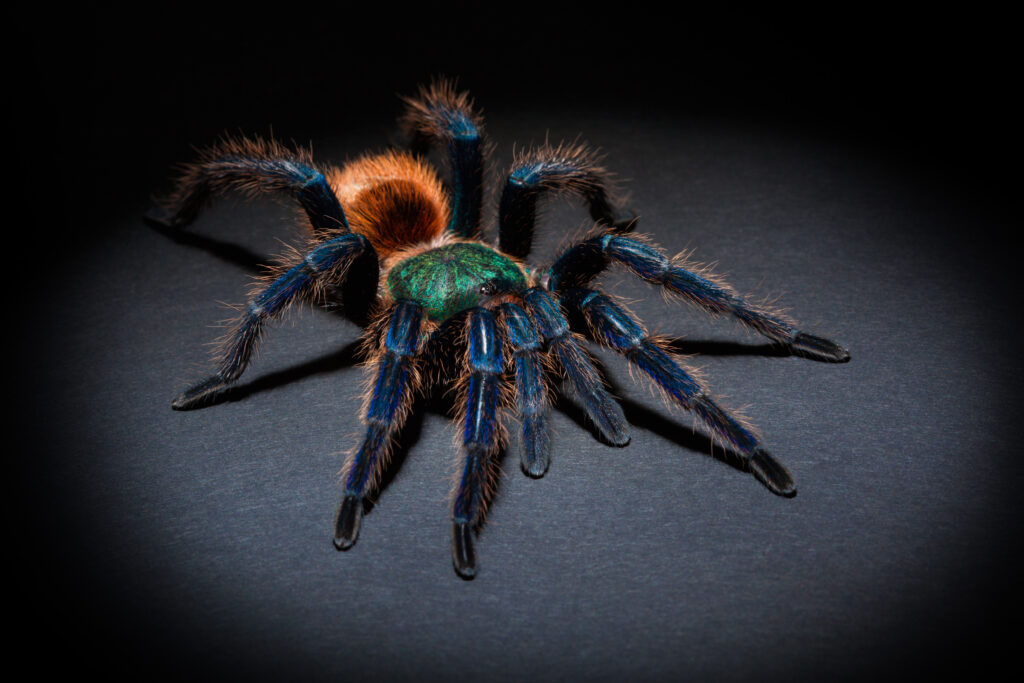
Spiders exhibit a wide range of behaviors and interactions in their environment, from their hunting techniques to their defensive tactics. Understanding these behaviors is critical for comprehending their role in ecosystems and their strategies for survival.
Diet and Hunting Methods
Most spiders are predatory and primarily feed on insects, though some larger species may prey on frogs, lizards, snakes, and rodents. They use various hunting methods such as using silken webs to ensnare prey or employing ambush tactics. For instance, the Brazilian wandering spider, a contender for the deadliest spider, actively hunts its prey at night. The orb-weaver spiders, on the other hand, rely on their webs to capture flying insects like crickets and flies.
- Venom & Fangs: Many spiders utilize venom delivered through their fangs to immobilize or kill their prey. The potency of the venom varies, with some, like the Brazilian wandering spider, capable of delivering a bite that can cause serious harm or even be fatal to humans.
- Silk Use: Besides capturing prey, silk is used for creating protective sacks for eggs or to aid in spiderlings’ dispersal through a process called ballooning.
Reproduction and Lifespan
The mating process for spiders can be perilous, particularly for males, who may become prey to the females. Spiderlings emerge from the eggs and are often left to fend for themselves. In terms of lifespan, spiders can vary greatly:
- Lifespan: Some species may live only for a year, while others, such as many tarantulas, have significantly longer lifespans, with females often living longer than males.
- Reproductive Habits: Tarantulas, for instance, may have significant maternal care, with the female guarding the eggs until they hatch.
Defensive Behaviors
To avoid predation, spiders have developed a range of defensive behaviors, which can include camouflage, flight, or more active forms of defense such as:
- Urticating Hairs: Tarantulas from the New World possess urticating hairs that they can kick off in defense, causing irritation to would-be predators and humans.
- Stridulation: Some species produce noise by stridulation, rubbing particular body parts together to deter predators.
- Aggression: When threatened, some spiders become aggressive, showing their fangs or assuming a menacing posture. The Brazilian wandering spider is known for its aggressive response when provoked.
Add comment