
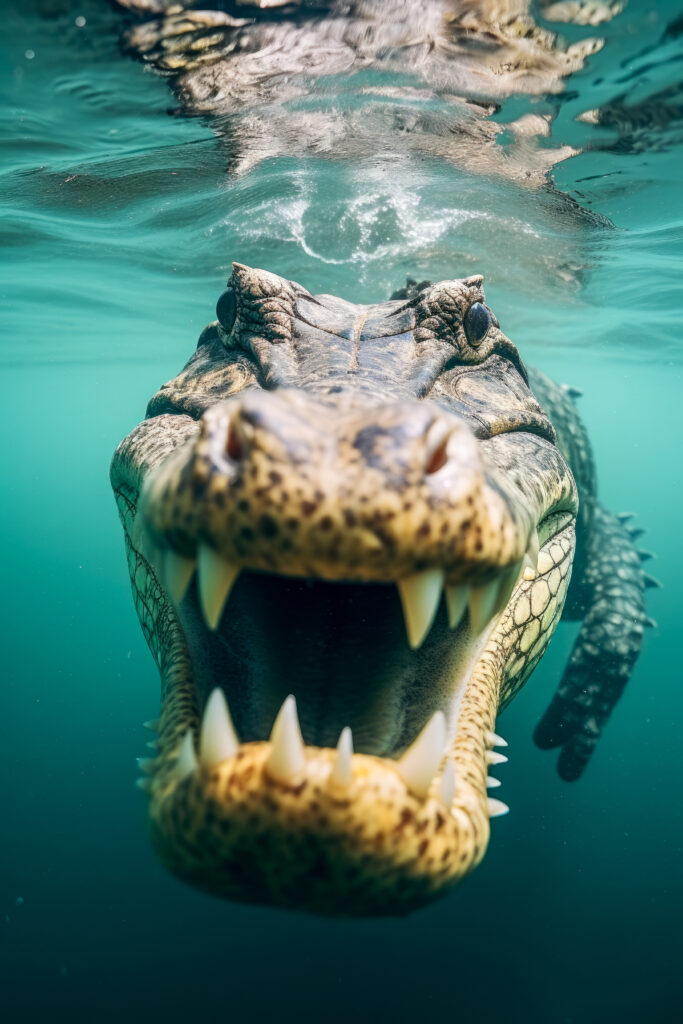
Sharks and alligators represent two of the most fascinating apex predators in the animal kingdom, each dominating their respective habitats with a combination of raw power and keen survival instincts. Sharks, often viewed as the quintessential predators of the marine world, have roamed the oceans for hundreds of millions of years. Their evolutionary success is underpinned by their adaptability and diverse range of species, which allows them to thrive in various aquatic environments from shallow coastal waters to the deep sea. In contrast, alligators are predominantly freshwater predators, ruling the rivers, lakes, and swamps of the Americas with an ancient lineage that speaks to their own enduring design.
Their paths seldom cross, with sharks patrolling saline waters while alligators are typically found in fresh or brackish environments. However, in certain areas such as the brackish Lake Pontchartrain near the Gulf of Mexico, there is potential for overlap, which has led to occasional intriguing encounters between these formidable predators. Despite differing domains, both creatures employ remarkable strategies for hunting and survival, relying on a combination of highly tuned senses and physical prowess to capture prey.
Table of Contents
Physical Characteristics

In the realm of apex predators, sharks and alligators boast distinct yet impressive physical characteristics. These attributes have evolved to suit their respective habitats and hunting styles, presenting a stark contrast in size, weight, and anatomy.
Size Comparison
Sharks:
- Size range: Varies greatly depending on species, with dwarf lanternsharks measuring under a foot, while whale sharks can exceed 60 feet.
- Weight: Can be relatively light or weigh as much as 21,000 pounds for the whale shark.
Alligators:
- Size range: American alligators can grow up to 13-15 feet in length.
- Weight: An adult male typically weighs between 500-1,000 pounds, while females are smaller.
Anatomical Differences
Head:
- Sharks have a streamlined head with a pointed nose to enhance their swimming efficiency.
- Alligators possess a broad, flat head with powerful jaws designed for crushing.
Teeth:
- Shark teeth are renowned for being sharp and replaceable, continuously growing in rows throughout their lives.
- Alligator teeth are conical and interlock when the jaw closes, allowing them to seize and hold prey effectively.
Scales/Tooth:
- Shark skin is covered in tiny, tooth-like structures called dermal denticles, which reduce drag and provide protection.
- Alligator scales are bony plates known as osteoderms or scutes, which function as armor and help with temperature regulation.
Behavioral Traits

Understanding the distinctive behavioral traits of sharks and alligators is critical to comprehend their roles in their respective ecosystems. Both species have evolved specific hunting tactics, predatory behavior, and survival strategies, allowing them to thrive in diverse environments.
Hunting Tactics
Sharks have evolved to become opportunistic predators, often striking their prey with incredible speed. Their hunting strategy involves their acute senses, including sharp vision and an extraordinary sense of smell. For instance, the bull shark (Carcharhinus leucas) exhibits versatility in both freshwater and marine habitats, leveraging its speed in open waters for a rapid, surprise attack on prey.
In contrast, alligators, notably the American alligator (Alligator mississippiensis), are known as ambush predators. They utilize their formidable night vision and stealth to lie in wait for unsuspecting prey, often near the water’s edge. This method allows them to conserve energy and take advantage of the creatures that come close.
Predatory Behavior
Sharks’ predatory behavior is largely influenced by their sensory capabilities. Hunting mainly by detecting vibrations through their lateral line, they can also identify prey at close range through electroreception.
Alligators exhibit strong predatory behavior by capitalizing on their powerful jaws to seize and hold prey. Once the alligator has a hold of its prey, it can perform a “death roll” to subdue larger prey, demonstrating their specialized tactics to secure a meal.
Survival Strategies
In their survival strategies, both sharks and alligators exhibit behaviors that contribute to their longevity and position as apex predators. Sharks may migrate vast distances to exploit food resources, displaying their ability to adapt to various prey and conditions.
Alligators rely on a combination of physical defenses, including tough, armored skin and strong tails. Moreover, they can regulate their body temperature by basking in the sun or retreating into the water, which can be crucial for survival when temperatures are extreme.
Both species tend to avoid unnecessary fights, although they will defend themselves fiercely if provoked. They have adapted to co-exist in ecosystems where their paths may cross, with each respecting the other’s formidable presence.
Habitats and Distribution

Sharks and alligators are apex predators that have adapted to very different ecosystems. The former primarily occupies saltwater regions, while the latter is found in freshwater environments.
Habitat Range
Sharks have a global distribution, extending from the deep ocean to the shallower coastal waters. Species like the tiger shark can be found in various locations, including the Gulf of Mexico, a region also frequented by bull sharks. These species are highly adaptable, making them a common sight in both open seas and estuaries. Some sharks even venture into freshwater.
American alligators, on the other hand, are predominantly located in the southeastern United States, notably in Florida, Louisiana, and Georgia. A significant population resides in the Everglades, a vast network of freshwater marshes, rivers, and lakes. Alligators are known for their presence in freshwater habitats but can also be found in brackish environments such as estuaries.
Adaptation to Environments
Sharks showcase remarkable adaptations to saltwater environments. The great white shark, for instance, has developed a keen sense of smell and the ability to detect electromagnetic fields, aiding in navigating the vast oceans.
Conversely, alligators have evolved to thrive in freshwater environments. They demonstrate this adaptability in the Shark River estuary, where the interplay between freshwater flow and tides creates a dynamic habitat, as shown in a study on alligator movements in the estuary. Alligators can regulate their internal salt balance, allowing some tolerance to saltwater, despite being freshwater creatures.
Conservation and Human Impact

The relationship between apex predators such as sharks and alligators, and humans has been a complex one, heavily influenced by conservation efforts and the attempt to balance ecosystem health with human activities like fishing. As top predators, both species play crucial roles in maintaining the ecological balance but face threats from habitat loss and human interference.
Conservation Efforts
Sharks: Conservationists are actively engaged in addressing the decline of shark populations due to overfishing and bycatch. For instance, the Florida Fish and Wildlife Conservation Commission (FWC) has established regulations that aim to protect these marine creatures, including size and bag limits for fishermen. The International Shark Attack File also contributes to better understanding shark behaviors to mitigate negative encounters with humans while advocating for their preservation.
Alligators: Efforts to conserve alligators in the United States have seen a historical turnaround, with alligator populations in places like Florida recovering from the brink of extinction in the last century. Protected under various management programs, alligator habitats are monitored, ensuring their survival and role in the ecosystem.
Conflict and Coexistence
Human activities can sometimes lead to conflicts with these apex predators, resulting in gator attacks or shark bites. Education and awareness campaigns by organizations help communities understand the importance of coexistence and methods to avoid such conflicts. Gator attacks, while relatively rare, are addressed by the Florida FWC, which provides guidelines on how to safely inhabit areas where alligators are present. Similarly, for sharks, techniques such as the use of shark deterrents are being researched and promoted to minimize the risk of shark bites.
This dynamic between humans and these wild animals underscores the need for continued conservation efforts that not only protect these species but also manage their interactions with people. Through such efforts, the delicate balance of the ecosystem can be maintained.


Add comment