
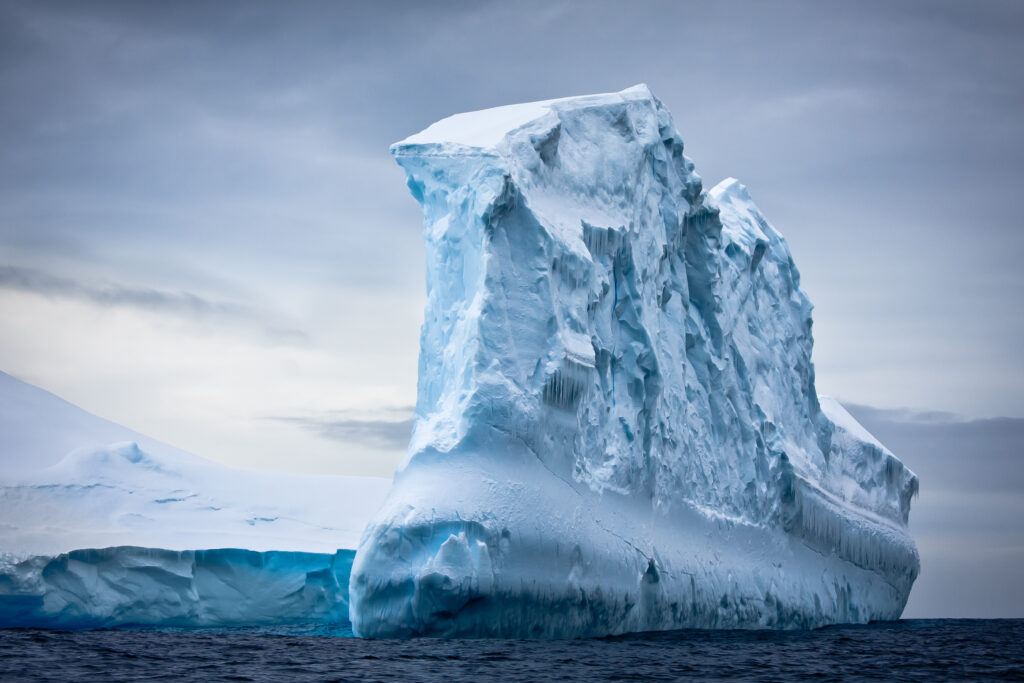
The world’s largest iceberg, A23a, has recently gained momentum after being grounded on the seafloor since the mid-1980s. The giant iceberg is now drifting at a rate of three miles each day, according to the British Antarctic Survey. Measuring approximately 1,500 square miles and 1,300 feet thick, A23a weighs around one trillion metric tons.
Scientists believe that the iceberg’s movement is a natural occurrence due to slight thinning. This thinning provides the iceberg with enough buoyancy to lift off the ocean floor and be pushed by ocean currents, as explained by Oliver Marsh, a glaciologist at the British Antarctic Survey.
While A23a does not pose any direct threats to human life, there are some potential consequences for wildlife. If the iceberg reaches the island of South Georgia, it may disrupt the foraging patterns of seals, penguins, and seabirds, as reported by BBC News.
Various studies show that large icebergs break off from Antarctica approximately once per decade. The frigid waters surrounding Antarctica can sometimes trap these icebergs and delay their melting, according to Chad Greene, a glaciologist at NASA’s Jet Propulsion Laboratory. A23a detached from Antarctica in August 1986 and remained grounded in the Weddell Sea until its recent movement was observed by Andrew Fleming, the remote sensing manager at the British Antarctic Survey.
Satellite images revealed that A23a was swept by currents and winds throughout 2022 and 2023, and its pace has been accelerating since. The massive iceberg might drift eastward due to the probability of getting carried by the iceberg alley, a path that transports numerous icebergs from the Antarctic Peninsula to the South Atlantic.
The A23a iceberg’s movement will be monitored carefully by scientists, as it is rare for such a large iceberg to move. Although people are safe from A23a, potential issues for wildlife may arise if it runs aground in breeding areas. However, melting icebergs can also provide benefits to the ecosystem by releasing mineral dust, a nutrient source for oceanic organisms.
Climate change has been causing Antarctica to lose ice at an alarming rate, confirmed Marsh and Ella Gilbert, a climate modeler at the British Antarctic Survey. The National Snow and Ice Data Center announced in September that this year’s Antarctic sea ice reached the lowest annual maximum ever recorded. It is crucial to take into account the impact of these ice losses on the environment and marine life throughout the world.
Add comment