
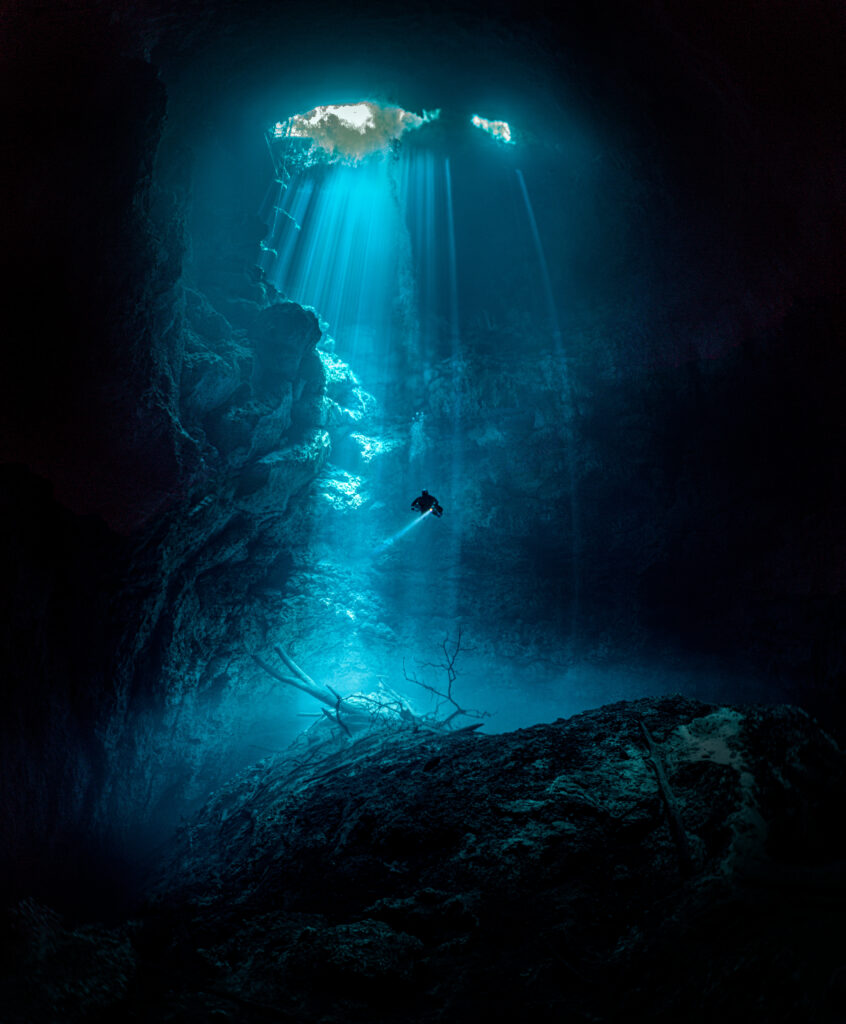
Northwestern University researchers, with the help of an experienced underwater cave-diving team, have created a comprehensive map of microbial communities living in the submerged labyrinths beneath Mexico’s Yucatán Peninsula. The researchers reached the deep, dark passageways of unlit waters, where previous researchers had only collected water and microbial samples from the cave entrances and easily accessible sinkholes. The researchers found that the microbial communities within the cave system tend to cluster into well-defined cliques, similar to a stereotypical high school lunchroom. One family of bacteria, Comamonadaceae, appeared at nearly two-thirds of the “cafeteria tables,” indicating that it is the ecological linchpin of the broader community.
The researchers collected 78 water samples from 12 individual sites within the cave system near the Caribbean coast in Quintana Roo, Mexico. They analyzed the samples to identify microbial communities by sequencing their DNA. They also considered the environmental context of each microbial community, including cave type, cave system, distance from the Caribbean coast, geochemistry, and position in the water column. The researchers found that the Yucatán aquifer’s microbiome varies substantially from the nearby sea, although water from the Gulf of Mexico flows into the Yucatán aquifer.
The Yucatán platform is essentially a Swiss cheese of cave conduits, and the researchers were curious which microbes are found together when they look across the whole system versus which microbes are found within one “neighborhood.” The resulting networks showed which species tend to live together. For each site, the researchers considered the environmental context of each microbial community, including cave type (pit or conduit), cave system, distance from the Caribbean coast, geochemistry, and position in the water column.
The researchers found that the microbial communities form distinct niches, with a varying cast of characters that seem to move around, depending on where you look. But when you look across the whole data set, there’s a core set of organisms that seem to be performing key roles in each ecosystem. The researchers found that Comamonadaceae, a family of bacteria typically found in groundwater systems, lived in several niches. They also discovered that a deep, pit-like sinkhole with a surface opening (allowing sunlight to spill in) housed the most microbial communities, segregated into layers of distinct niches throughout the water column.
The findings hint that Comamonadaceae is the ecological linchpin of the broader community. The researchers noted a system rich with diversity, organized into distinct patterns. The underground river system provides drinking water for millions of people. So, whatever happens with the microbial communities there has the potential to be felt by humans.
Add comment